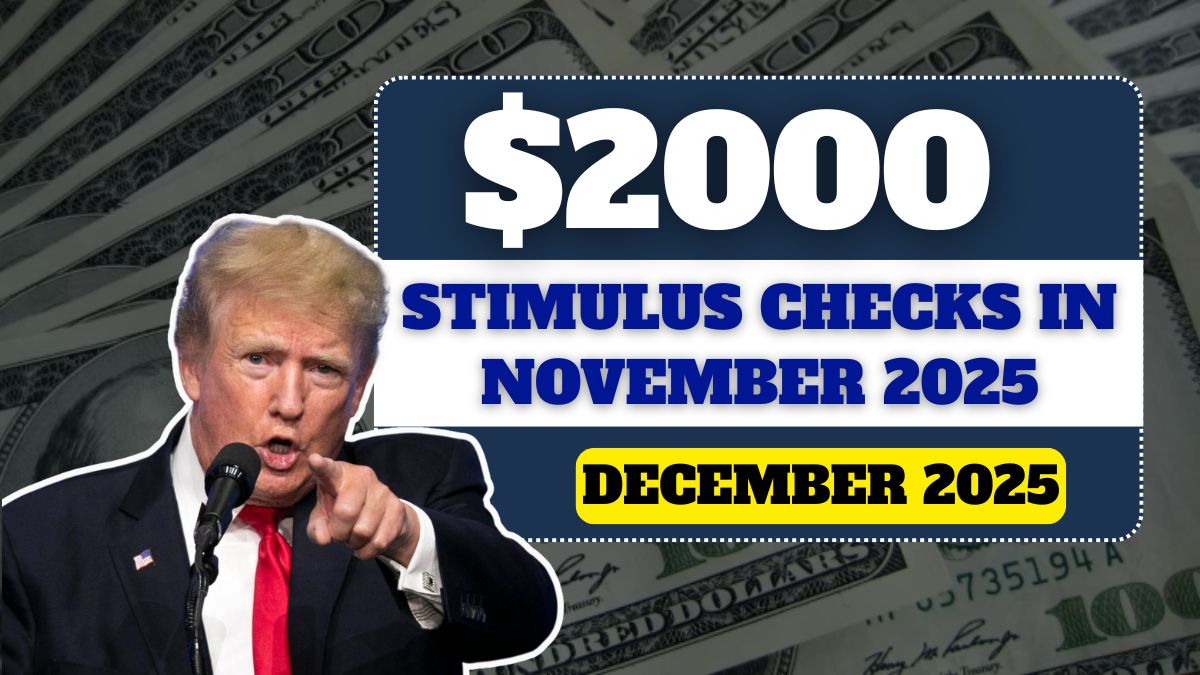
As soon as the news broke that the IRS had announced a $2000 direct deposit, millions of families across America felt a glimmer of hope. In this era of inflation, where everyday expenses are constantly rising, any kind of additional financial assistance becomes a great relief for ordinary people. Managing budgets amidst rent, groceries, fuel, medicines, and other essential needs has already become difficult. In such a situation, a $2000 payment can help many families achieve some stability.
The announcement also clarified that those who are eligible will receive this payment automatically. They will not need to apply separately. The IRS plans to ensure that eligible taxpayers and federal benefit recipients can access this assistance without any additional procedures. However, various discussions and political statements are also emerging on this entire issue, and it is crucial to understand the difference between the truth and the proposals.
Table of Contents
The $2000 Direct Deposit and the Related Issue of Tariff Dividends
Along with the discussion of the $2000 direct deposit, the issue of the “tariff dividend” proposed by former President Donald Trump has also resurfaced. Trump claims that the additional revenue the government receives from tariffs levied on international trade can be used to provide a $2000 benefit to American citizens. According to him, this tariff revenue strengthens federal income, and on that basis, such a dividend is possible.
Trump has also maintained that critics of his tariff policies have not properly understood their benefits. However, it is important to understand that the tariff dividend is currently only a proposal. Its full implementation would require congressional approval, budget allocation, and clear regulations. Currently, it is being viewed as an idea or a plan, not a fully approved federal payment.
IRS $2000 Direct Deposit 2025: A Quick Overview
It is important to understand the basic information related to this proposal and discussion. This plan is reportedly associated with the Internal Revenue Service (IRS) and aims to provide financial assistance to low- and middle-income individuals. The proposed amount is $2,000, and the payment method is expected to be direct deposit. The program could potentially cover various tax filing statuses, including single filers, married couples, and heads of household. However, no final plan has been confirmed on the official IRS website, IRS.gov.
Citizens’ Expectations and Federal Limitations
While there is excitement among the public regarding the $2,000 direct deposit, several legal and financial limitations are involved. Any federal payment cannot be implemented without full approval from lawmakers. Furthermore, the structure of the plan could change during budget negotiations. Most importantly, the future of the funding model for this payment depends on the revenue generated from tariffs.
According to current indications, a decision on this entire process may not be reached until 2026. Therefore, it is premature to say when and how this payment will be implemented.
Potential Eligibility Rules for the $2000 Direct Deposit
Experts are speculating, based on previous stimulus payments, that if this plan moves forward, the eligibility rules will likely be similar. In previous relief packages, full benefits were provided to single filers with incomes up to $75,000. For married couples, this limit was set at $150,000. Payments were gradually reduced for those with higher incomes.
There is also discussion that the income limits might be made stricter to control costs. Some reports suggest that a $100,000 individual income limit might be considered in the future. However, all of this is currently speculative, and no official rules have been established.
The Cost and Funding of the $2000 Direct Deposit
The biggest question surrounding this plan is its cost. According to available data, the US has collected approximately $195 billion in tariff revenue so far. If approximately 150 million Americans receive $2000, the total cost could reach around $300 billion. This means there could be a funding shortfall of approximately $105 billion.
This is why policy experts are cautious about this plan. They believe that relying solely on tariff revenue to fund such a large payment could be economically challenging.
Policy and Economic Impact
If this payment is implemented, it will provide short-term relief to families. However, there are also some associated risks. Economists believe that if additional pressure is placed on funding, inflation could increase. Since tariffs have already increased the prices of many consumer goods, the real benefit of the $2000 amount might be somewhat diminished.
Furthermore, uncertainty remains regarding future revenue, which could impact the federal fiscal balance in the long run. Long-Term Financial Outlook
Looking at long-term figures, it’s estimated that tariffs could generate approximately $3 trillion in revenue over the next 10 years. However, if a $2,000 payment were made annually, the annual cost would be around $300 billion. Meanwhile, the US’s current federal debt already exceeds $38 trillion. Therefore, sustaining such a program over the long term would not be easy.
White House Stance
The White House has indicated that such payments are being considered. There has been support for the proposal at the presidential level, but policy experts are still working on the implementation details. How the payments would be administered through the IRS and how eligibility would be determined based on income are among the issues that still lack clear direction.
Latest Updates on the $2,000 Direct Deposit
Currently, the most important point is that this $2,000 tariff dividend is not yet a fully approved federal payment. It is still in the discussion and evaluation phase. Neither congressional approval nor a concrete funding plan, eligibility rules, or payment dates have been established. While the president has expressed support, until an official announcement and legal approval are given, it should be considered only a proposal.
Conclusion
The discussions surrounding the $2,000 direct deposit by the IRS offer hope to the public, but the reality is that this plan is still in its developmental stages. While any form of relief is necessary for people during this period of inflation and economic pressure, several economic, legal, and policy aspects must be decided before such payments can be implemented. Therefore, citizens should rely only on official IRS and government announcements and disregard rumors. Until clear approval, funding, and a payment schedule are announced, understanding the $2,000 direct deposit as a proposed plan is the most accurate and safe approach.
FAQs
Q. Is the $2000 direct deposit officially approved by the IRS?
A. No. The $2000 payment is currently a proposal under discussion and has not received final congressional approval.
Q. Do taxpayers need to apply for the $2000 direct deposit?
A. If approved in the future, payments would likely be issued automatically, but no application process has been confirmed yet.
Q. Who would be eligible if the $2000 payment is approved?
A. Eligibility would likely focus on low- and middle-income individuals and families based on income and tax filing status.
Q. When could the $2000 direct deposit be sent?
A. There is no confirmed payment date. Any timeline would depend on legislation, funding approval, and economic conditions.
Q. Is the $2000 payment the same as a stimulus check?
A. No. It is being discussed as a tariff dividend proposal, not an approved stimulus or relief payment.